

SpaceX: What does it mean for investors?
Few companies have captured investors' imagination like SpaceX. With leadership positions in commercial space launch, satellite communications, defense contracting, and space infrastructure, SpaceX has become one of the most valuable private companies in history. Reports suggest the company may seek a public valuation approaching or exceeding $1.5 trillion, making it the largest Initial Public Offering (IPO) ever brought to market.
For perspective, Facebook's 2012 IPO debuted at approximately $104 billion. SpaceX could enter public markets at a valuation 15 times (or more) that of Facebook. It’s notable that Facebook, or Meta as it is now known, is not SpaceX; they are distinctively different companies and there are only so many parallels that can be made between them. However, we think it is constructive to look at what Meta has done in the years since its IPO in 2012.
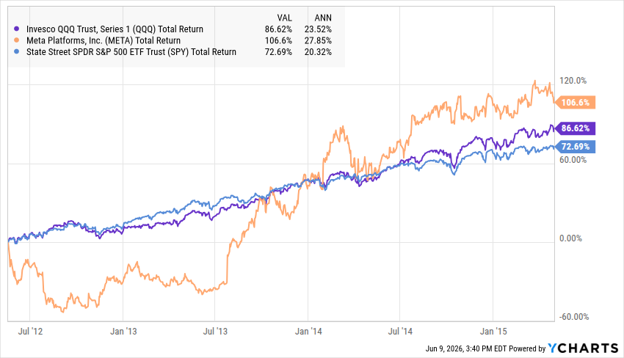
Below you will see a chart of Meta and a comparison to the Invesco QQQ Trust which is the top 100 companies traded on the Nasdaq as well as SPY which is an S&P 500 Index ETF. In the year and half period after Meta came to market, it underperformed both of those assets. Then, around the beginning of 2014 it started to outperform the broader markets.
In the next chart below, you will see a longer time horizon of the same assets over 10 years. This illustrates that Meta’s returns were similar to the QQQs, but notably it maintained a strong annualized edge on returns over the S&P 500.
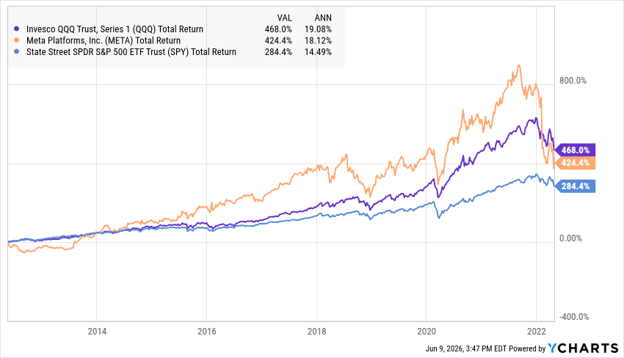
We think these charts reveal the nuances of how many large IPOs can playout. Caution is often prudent in the earliest phases, but if the company is fundamentally strong it can and should be part of an long-term investment strategy. The next question is how should a smart investor make SpaceX part of their portfolio? For most investors, we believe the passive index will do an appropriate job of incorporating SpaceX similar to the way in they include other mega large cap companies.
Why Index Investors Should Pay Attention?
In earliest days following the SpaceX IPO, institutional investors and retail investors will be buying individual shares of SPCX (the ticker symbol for SpaceX) at market rates. Later, the most likely ways in which investors will achieve ownership of SPCX will be through mutual funds and Exchange Traded Funds or ETFs. The largest share of investor wallet is in passive index funds like those listed below. Be sure to note the timeline for when these index funds will likely start to buy SPCX inside their respective portfolios.
Index | Estimated Timing | Considerations |
Russell 1000 | SPCX will be added as soon as 5 days after IPO. | This benchmark is widely purchased and represents the 1000 largest cap domestic companies. |
Nasdaq QQQ Trust | SPCX will be added as soon as 15 days after IPO | 100 largest companies traded on Nasdaq. |
S&P 500 | SPCX will not be included for at least 12 months after IPO | This is the traditional “seasoning period” for inclusion, plus profitability requirements must be met and SpaceX is currently not profitable. |
Potential Risks and Challenges
As exciting as the SpaceX opportunity is, a measure of investor caution is often prudent. Some of the challenges SpaceX and the market at large may experience are:
1. Valuation Risk
Large IPOs often arrive after years of private-market appreciation. High expectations can leave little room for disappointment.
2. Concentration Risk
If SpaceX becomes a significant weight in major indexes, passive investors may gain substantial exposure to a single company and founder. Likewise, if investors over concentrate on a single asset in their portfolio this can create substantial risks.
3. Historical IPO Volatility
Facebook's IPO serves as a reminder that even transformational companies can experience difficult starts. Meta shares declined significantly after going public before ultimately becoming one of the market's great success stories.
4. Index Rebalancing Effects
Large passive purchases may require selling other stocks to make room for SpaceX, creating temporary distortions across market segments.
5. Retail Investor Speculation
Reports suggest unusually large retail participation may occur in this offering, potentially increasing short-term volatility.
Our Perspective
SpaceX is exciting! Elon Musk is a formidable CEO who should not be underestimated in terms of his ability to build innovative and highly investable companies. We like the long-term prospects of SpaceX.
As fiduciaries, however, our responsibility is not to predict headlines or chase excitement. Our responsibility is to evaluate whether an investment offers an appropriate balance between expected return and risk within the context of a client's long-term financial plan. We always go back to YOUR financial plan and evaluate what to include in your portfolio. If you feel like your plan needs discussion or updating in any way, reach out to us now. We are here to help align your dreams and goals. It’s likely that a part of your holistic financial plan will include SpaceX…but how much and when are critical questions we will help you answer.